


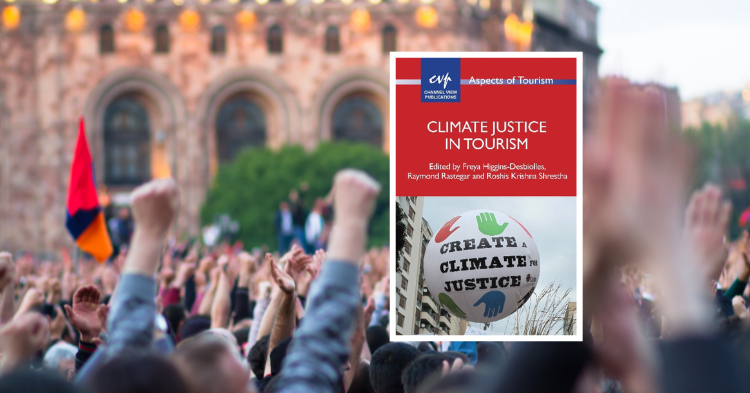
Tourism is associated with travel, holidays, and fun. But tourism is also a driver of impacts that are felt unequally – and those impacts are being intensified by climate change. This is now the focus of attention among tourism scholars researching in the field of climate justice.
Transcript
Today marks the start of Season 3 of my ‘Checking In’ podcast which explores the challenges and opportunities of sustainable tourism … in all of its richness and complexity. One such challenge relates to climate justice which has emerged in recent years as a field of enormous relevance and importance to tourism.
Climate justice in tourism recognises and responds to the uneven distribution of the benefits and burdens arising from tourism. It raises uncomfortable questions about who wins and who loses when it comes to tourism development, and who holds the power to (re)shape tourism in response to concerns about equity and justice. These are questions that are becoming increasingly urgent due to the continued failure of government responses to the UN’s climate targets for 2030 and beyond.
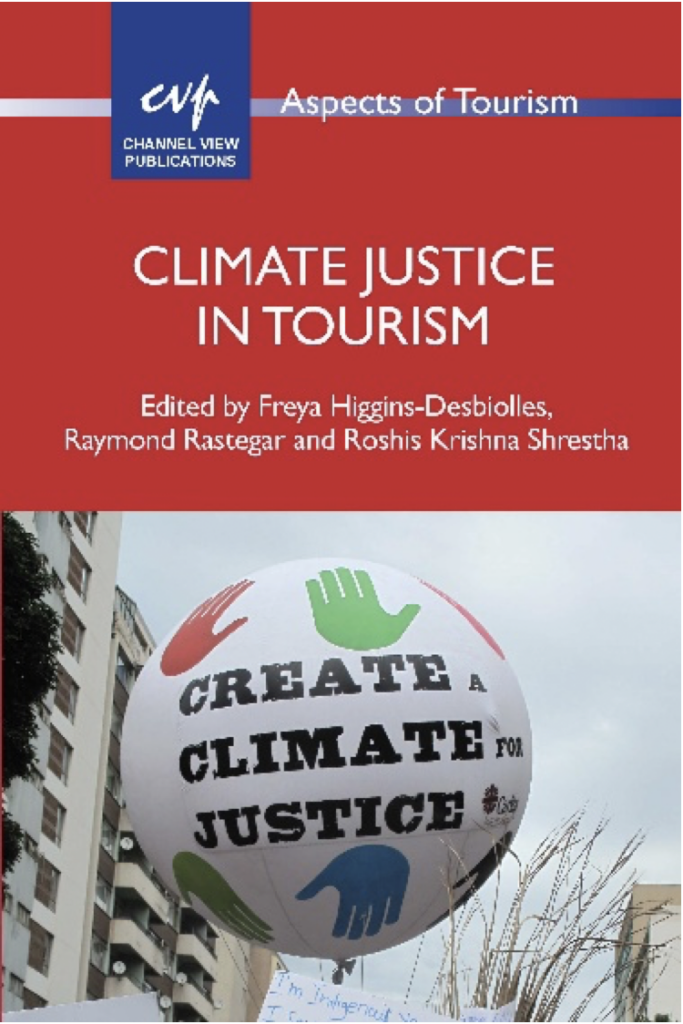
So where better to start Season 3 than with a conversation about climate justice in tourism with Freya Higgins-Desbiolles, who is the co-editor of a just-published book this subject.
Welcome to Checking-In Freya. Your co-edited book Climate Justice in Tourism is officially published today – so congratulations to you and your co-editors.
So Freya let’s begin at the top – why a book on Climate Justice in Tourism and why now?
The most immediate catalyst for this book was my involvement with the “Climate Justice in Tourism: An introductory guide” supported by the Travel Foundation. That project did a scoping study of the emerging issues of climate justice in tourism and interviewed a number of tourism stakeholders from around the world to gain their perspectives.
Knowing this was only the beginning of addressing this vital topic, I spoke with Sarah Williams of Channel View Publications and found she was keen to advance an edited book project to explore the issues further in an academic way. I then reached out to Drs Raymond Rastegar at Griffith University and Roshis Khrishna Shrestha (Hong Kong Polytechnic University) to form an editorial team with broad interests in justice in different contexts and with diverse networks of relevance.
Because the book’s topic has such immediacy, we gathered contributors and put the manuscript together quite quickly. The book provides a justice framework for thinking through the issues, a vocabulary for uncovering power dynamics, numerous case studies to expose the complexities and pointers on how to take future work forward. It contains 14 chapters and is divided into four sections: The Challenge of Climate Change for the Tourism Sector; Destinations and Communities, Governance (In)justices in Tourism; Case Studies; and Imagining More Just Tourism Futures. The foreword was written by Jeremy Smith, co-founder of Tourism Declares a Climate Emergency and co-author of the UN Tourism-led Glasgow Declaration on Climate Action in Tourism.
Why is tourism a matter for discussions of justice and injustice?
We often think of tourism as a simple matter of holidays or a policy or business context to manage. However, tourism is a powerful force of impact in economic, social, political and ecological terms. It therefore brings concerns with equity and justice. At the most basic level, you have movements of people facilitated by complex systems to the home environments of others, to enjoy the amenities and extract pleasure. This comes with a variety of consequences and impacts. Questions of who benefits, who is impacted, who decides and what are the acceptable trade-offs are centred as we begin to think about justice.
So what is climate justice in tourism?
Climate justice in tourism spotlights the unfair distribution of benefits, burdens and decision-making power in the creation of the climate crisis and responses to it. It is often said that those that have contributed least to the climate crisis are the most impacted. This focuses attention on Global North and Global South inequities but not exclusively – it also includes injustices for women, gender diverse, Indigenous, disabled peoples and marginalised groups who may reside in the Global North also.
In terms of tourism specifically, the inequities we grapple with are the non-essential consumption of privileged travellers, and the tourism and travel sector’s great contribution to emissions juxtaposed against the climate impacts the tourism-dependent nations of the Global South and small island developing states (SIDS) bear (such as climate refugee movements). Understanding these facts, we must negotiate a “just transition” that centres “vulnerable” populations, fair resource use and equitable participation in decisions. A climate justice lens prompts us to change our policy focus from technological and managerial fixes (e.g. “sustainable” aviation fuels for planes, emissions reductions targets) to deeper social and political transformations that address equity and justice.
To make this concept more concrete I can give an example of the Harmful Algal Bloom (HAB) occurring here in South Australia and its impacts on First Nations communities. This event is a climate change disaster. Environmental scientists and First Nations have noted that pre-colonisation, well cared for marine areas that had oyster beds and sea grasses that prevented HABs and kept marine ecologies balanced. With the current HAB, described as the worst in the world, governments failed to consult First Nations early in the crisis response. First Nations leaders have declared it a cultural emergency as their communities are disproportionately impacted with cultural loss, spiritual harm and business losses in tourism and hospitality. Nations such as the Ngarrindjeri have been warning governments of ecological mismanagement for decades and feel historical legacies carry through to today. In this case we can see how climate crises and responses to climate crises are connected to matters of justice.
What are some of the critical issues of climate injustice for the tourism industry to consider?
Our book has chapters addressing numerous issues for the tourism industry to consider. At a foundational level, understanding historical contexts for structural injustices is vital for understanding the uneven terrain between Global North and South, as well as Indigenous communities in settler colonial states as we face the task of addressing climate change. This is seen for example in Prof Mimi Sheller (Worcester Polytechnic Institute) et al.’s chapter on climate just mobilities for the US Virgin Islands and the ongoing legacies of colonisation.
Additionally, we all need to understand the complexity of the issues and the trade-offs that may be necessary in addressing climate change in a just way; for example the tensions between reducing long haul flight emissions and the real vulnerability of Island nations’ tourism dependency. There are also specific domains of Indigenous rights and knowledges and gender justice that call out for consideration.
As you mentioned your book is organised into four thematic sections. The first addresses the Challenge of Climate Change for the Tourism Sector, Destinations and Communities
Section 1 discusses the uneven impacts of climate change on tourism and reveals that tourism may not present the “win-win” solution for development and sustainability that it is frequently touted to. For example, Chapter three, by Gerben Broekema (Gerben Aviation Advisory Services) et al., focuses on aviation policies, examining the impacts of the reduction of flying during the Covid pandemic in order to analyse the socio-economic implications of aviation climate policies, particularly for tourism dependent countries such as Fiji and the Maldives. Their findings indicate the need for a just transition as policymakers work to decarbonize tourism.
Section two then focusses on Governance (In)justices in Tourism
The second section dives deeper into systemic issues that deepen climate inequalities. Chapter four, by Angel Sulub (Permanecer en la Tierra) and Daniela Subtil Fialho, frames air travel as a pillar of global inequality by engaging with the Stay Grounded network’s advocacy for aviation degrowth and climate justice. Drawing on the case of the Mayan people in Mexico, this chapter advocates for a just transition, calling for drastic reduction in air traffic, reparation of climate debts and the prioritisation of Indigenous land rights. Chapter six, by Mimi Sheller et al. explores mobility justice in the US Virgin Islands, showing how historical colonialism, extractive industries and contemporary tourism infrastructure perpetuate unequal mobilities.
Having addressed destinations and communities, and goverance in parts one and two, the third section then addresses Case Studies in Climate (In)justice in Tourism
Section three engages the issues of climate injustice by examining cases from Kenya, Palestine, Greenland and Tyrol. Chapter seven, by Judy Kepher Gona (Sustainable Tourism & Travel Agenda) and Lucy Atieno (Bremen University), examines the unequal power relationships among carbon developers, tourism investors and pastoral communities in Kenya’s nature conservancies. It critiques the ‘triple-win’ narrative of carbon markets, arguing that carbon markets perpetuate colonial approaches to resource management. The cases in this section illustrate how climate injustice is embodied and contested, emphasising the importance of Indigenous self-determination and offering lessons in collective resilience and agency.
And the final section delves into Imagining More Just Tourism Futures
That’s right. Section four calls for rethinking tourism practices, including adoption of regenerative practices, relinquishment of growth-centric models and restoration of Indigenous-led economies as pathways for climate justice and socio-ecological transformation. A great example is Chapter ten, by Kehana Andrews (University of the Sunshine Coast) et al., reporting on Vanuatu’s Regenerative Vanua project that employs a holistic model of regenerative intercultural hosting. This work challenges tourism’s extractive patterns, emphasising Indigenous leadership and epistemic justice to empower custodians for leading climate resilient futures.
The cynics might question whether global policymakers and national governments are capable of meeting these challenges, so how might the tourism industry address climate justice issues?
The vital first step for the tourism industry is to listen to the voices from the impacted Indigenous communities, SIDS and the Global South (as expressed in annual climate change conferences for example and in the chapters of our book) and support their calls for fair action such as the Loss and Damage Fund, reparations and respect for Indigenous rights. At a more fundamental level, injustices are derived from power imbalances which need to be addressed, including who exactly sets the agenda, who is invited to the table and who makes the decisions.
For their part, the tourism industry and planners need to be able to think from local to global levels for the supportive roles they might play. For instance, the Travel Foundation’s Report “Climate Justice in Tourism” offers 10 ideas for collaborative action for scaling climate justice. Undertaking training and building collaborations are vital so that meaningful action can be progressed – preventing climate washing. Links to the Travel Foundation and Rise Travel Institute are provided in the briefing notes.
This must be complemented by local connections, collaborations and actions (e.g. in Aotearoa most obviously starting with dialogue with iwi, Islanders and other impacted communities). Scoping out again, as Jeremy Smith notes in our book, we are also called on to rethink what kind of tourism might take us into a better future – one less growth-driven, slower and more engaged with people and place.
*****
The pre-publication reviews note that this book offers a treatment of climate justice in tourism in ways that reach beyond carbon emissions to attend to the systemic injustices of colonialism, neoliberalism, globalisation and anthropocentrism (James Higham, Griffith University). It examines tourism’s entanglement with climate injustice across diverse geographies. From carbon offsetting’s colonial dynamics to Indigenous frameworks for regenerative hosting, it reveals structural inequalities, while offering practical pathways towards justice. It will be compulsory reading for scholars, practitioners and policy makers who care about climate change and who are committed to just climate action (Vincie Ho, Founder and Executive Director, RISE Travel Institute).
The link to the book Climate Justice in Tourism is available in the podcast transcript on my website jameshigham.com/pod. There you will also find a discount code if you are thinking about purchasing this book – the discount code is valid until the end of May 2026.
Freya, thanks again for joining the podcast today and I hope your book reaches the wide readership that it deserves.
Link to book: https://www.channelviewpublications.com/page/detail/?K=9781836460091
Link to flyer with discount code – here.
References
- Becken, S. & Rastegar, R. (2025). Advancing climate justice in tourism: A critical evaluation of the TPCC Stocktake, Annals of Tourism Research, 113, 103962, https://doi.org/10.1016/j.annals.2025.103962. https://www.sciencedirect.com/science/article/pii/S0160738325000684
- Bigby, B.C., Smith, J., & Higgins-Desbiolles, F. (2024). Climate Justice in Tourism: An introductory guide. Travel Foundation. https://www.thetravelfoundation.org.uk/wp-content/uploads/2024/07/Climate_Justice_Tourism_v5.pdf
- Higgins-Desbiolles, F., Rastegar, R., & Shrestha, R.K. (Eds.) (2026). Climate Justice in Tourism. Channel View. See https://www.multilingual-matters.com/page/detail/climate-justice-in-tourism/?SF1=work_id&ST1=CVIEW-68bee9033519b
- Rastegar, R., Higgins-Desbiolles, F., & Ruhanen, L. (2023). Tourism, global crises and justice: rethinking, redefining and reorienting tourism futures. Journal of Sustainable Tourism, 31(12), 2613–2627. https://doi.org/10.1080/09669582.2023.2219037. https://www.tandfonline.com/doi/full/10.1080/09669582.2023.2219037#abstract
Recommended Links
- Griffith Institute for Tourism – Climate Justice and Tourism research cluster. Griffith University. https://www.griffith.edu.au/research/business/institute-tourism/our-research/climate-change-action-cluster/climate-justice-and-tourism
- Carbon Literacy and Climate Justice Workshops for Travel and Tourism Professionals, RISE Travel Institute. https://www.risetravelinstitute.org/carbon-literacy-climate-justice-workshops
- Tourism Cares “Introduction to Climate Justice” module https://www.tourismcares.org/climate-justice
Interviewee: Freya Higgins-Desbiolles, Adelaide University (on behalf of the editorial team including Raymond Rastegar and Roshis Krishna Shrestha)
Co-Editor Biographies
Freya Higgins-Desbiolles is an Adjunct in Tourism Management, Business and Law Faculty, Adelaide University (Australia). She has worked with industry, community and non-profits on projects that address community in tourism, human rights and justice. Her contributions have introduced ideas such as “tourism as a social force”, “socialising tourism” and defining tourism by the local community to tourism’s study and practice.
Email: freya.higgins-desbiolles@adelaide.edu.au
Raymond Rastegar is a researcher with the Department of Tourism and Marketing, Griffith University where his scholarly work focuses on justice, sustainability transitions, and environmental conservation. His research explores how sustainability transitions can foster inclusive and equitable futures at local, national and global levels. He is particularly interested in developing theoretical and empirical foundations that integrate justice into sustainability transitions, offering insights to guide tourism communities and inform policy responses.
Email: r.rastegar@griffith.edu.au
Roshis Krishna Shrestha obtained his PhD in Business and Economics at the Research School of Management at the Australian National University in December 2023. He joined School of Hotel and Tourism Management, Hong Kong Polytechnic University as a Research Assistant Professor in January 2024. Before embarking on his academic career, Roshis gained over five years of managerial experience in various sectors in Nepal, including automotive and consumer durables industries. His research interests include Indigenous tourism, sustainable tourism, culture and heritage tourism, and rural tourism as applied to his native Nepal. Roshis has special interests in ethnographic methods and grounded theory.