




For most people, booking a holiday is about sunshine, relaxation, and getting away from it all. But now, around the world, millions of people are making travel decisions that are deeply political – and nowhere is that more evident than in the retreat from America.
Transcript
What do we think about when booking a holiday? We weigh up the cost of flights, the quality of hotels, the exchange rate. We scroll through photos of places we dream of visiting. Perhaps we think about food, about culture, nature, adventure. What about geopolitics?
When did you last think about tourism as a political act?
Karen Newton – a 65-year-old British grandmother – will have been reflecting upon this question in recent weeks. Travelling on a valid tourist visa, she was handcuffed, driven twelve hours through the night to an Immigration and Customs Enforcement (ICE) detention facility, and held there for forty-five days. When she asked why she was being held, she was told she was guilty by association. Her husband’s visa had expired. Karen Newton’s message to other travellers, on her release, was unambiguous: Don’t go. It’s totally out of control over there.
A poll conducted in January by The Independent‘s travel correspondent Simon Calder found that 80% of British readers would now avoid travelling to the United States, with only 11% saying they would still go, and around one in seven of those who had already booked were considering cancelling — a sentiment echoed in reader comments that mentioned concerns about intrusive border checks, the threat of social media scrutiny, ICE’s disregard for tourist status, and general political tension and unease. One British resident who had lived in California for 30 years advised friends and relatives against visiting. Others commented on cancelling World Cup plans and redirecting holiday elsewhere. The general tone of comments was captured by one commenter who said that ” it’s no longer a safe or welcoming place for tourists.”
Some interesting questions arise from the circumstances in the US currently:
- Does it matter where you choose to spend your tourist dollars?
- What happens when a country’s government makes visitors feel unwelcome or at risk of arrest and detention?
- And – is a holiday a political statement?
The answers, it turns out, are far from simple. And they are reshaping the global tourism industry in ways that economists, governments, and academics are only beginning to understand.
****
It is useful to begin with the meta-governance of tourist mobility – a concept that has emerged recently in the tourism literature. This concept describes the rules that shape who can travel, where, and under what conditions. These rules include visa regulations, border controls, bilateral agreements, international conventions, and diplomatic relations between countries. In normal times — or what we might now nostalgically call normal times — these rules operated quietly in the background. Tourists barely noticed them and rarely had reason to even think about them.
But these are not normal times.
In an editorial published in the journal Current Issues in Tourism in January, Professor Michael Hall asked if his editorial might prevent him from travelling to the United States. He was making a serious point about the way in which academic commentary, political opinions, and social media histories are increasingly being treated as legitimate grounds for suspicion at the US border.
His question reveals something profound: that the meta-governance of tourism — the entire framework of rules, norms, and freedoms that makes international travel possible — is being undermined in the US. And when that framework is dismantled, the consequences ripple far beyond politics. They reach into every corner of the tourism industry.
****
Many previously ‘taken for granted’ aspects of tourism have changed, all of which make the US more unwelcoming.
First are new travel bans. Full entry restrictions now apply to nationals of twelve countries — Afghanistan, Burma, Chad, the Republic of the Congo, Equatorial Guinea, Eritrea, Haiti, Iran, Libya, Somalia, Sudan and Yemen. Partial restrictions have been added for dozens of other countries. The effect is not only felt in inbound tourism. It also affects outbound travel by residents of the United States who hold these nationalities, creating uncertainty about whether they will be permitted to return if they leave the country.
Visa fees have also been revised. The Electronic System for Travel Authorization (ESTA), used by citizens of the 42 countries in the visa waiver programme — was doubled to US$40. A separate visa integrity fee of US$250 was introduced for tourist and business visas. For many travellers from non-visa-waiver countries, the total cost of a visa now approaches US$440. The US now has one of the most expensive visa fees in the world.
Third, and perhaps most alarming, are the new data requirements. Proposed ESTA requirements include five years of social media history, ten years of email addresses, family members’ names and dates of birth, biometric data including fingerprints, iris scans and DNA, IP addresses, and business contact details. Amnesty International UK described this as wildly out of proportion to any legitimate border need. Entry into the USA has become problematic for anyone who might have negative views of the president and the current adminitration.
Not only has the US has become less welcoming, there is now a climate of fear and unpredictability. ICE has been given expanded powers. International tourists have been detained – some, as we have seen in recent reporting from the Guardian and the Independent, without any clear justification.
****
Hall’s editorial also reports on data from the US International Trade Administration covering the period January to September 2025. Overall international arrivals to the United States were down by more than 5% compared to the same period in 2024 across all of the major regions. Western European arrivals fell by 3.0%. Asia was down 3.6%. Africa declined 9.6%. Oceania fell 5.4%. Caribbean arrivals dropped 4.5%.
Some of the country-specific figures are even more striking. Denmark – a country provoked by repeated assertions that the United States should acquire Greenland by force – saw tourist arrivals to the US fall by 24%. Germany was down 13%. France dropped 7%. Student visa holders from Asia fell by 16%.
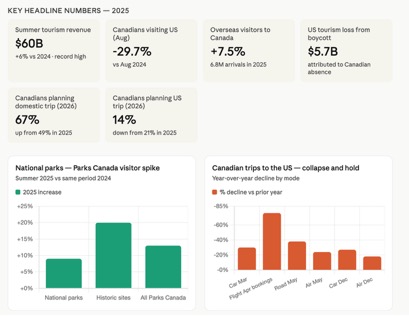
But what is particularly significant is what is happening to Canadian tourists. Canadians have traditionally been the largest single group of international visitors to the United States, making up almost a quarter of all foreign travellers to the US in a normal year. Canadians spent US$20.5 billion in the US in 2024, supporting an estimated 140,000 American jobs. That flow of people and money has collapsed. In May 2025, Canadian visits to the US by car fell 38%. Air travel fell 24%. In August 2025, Canadian trips to the US were down 29.7% compared to August 2024.
The US Travel Association has estimated the total economic loss attributable to the decline in Canadian tourism alone to be over US$5.7 billion in 2025.
****
Professor Stefan Gössling, writing in the Journal of Sustainable Tourism in February 2026, identifies other deeper factors at play. He argues that tourism – as a sector that is reliant on fossil fuels, digital platforms, and cross-border mobility, exemplifies the structural dependencies that now define Europe’s relationship with the United States. American technology companies — Meta, Google, Amazon, Microsoft, Apple — control the digital infrastructure through which tourism operates. American hotel chains own a significant share of European accommodation. American payment systems process a significant share of European tourism transactions.
For Stefan Gössling, we are witnessing a geopolitical shift – the rise of a unilateral, transactional, America-first approach to international relations that is fundamentally at odds with the multilateralism that international tourism has long depended upon. He positions this in terms of Trump v Europe, suggesting that Europe might respond by using tourism governance strategically, through reciprocal visa fees, regulation of digital platforms, and commission caps for dominant US-based booking platforms. He also calls for an overdue energy transition away from fossil fuels which is being further accelerated by war with Iran and the closure of the Gulf of Hormuz.
There is an irony here – that the very structures that once made the United States the world’s most powerful and attractive destination – its openness and global cultural reach – are now being used as instruments of control, extraction, and exclusion.
****
Michael Hall makes important observations of geopolitics and tourism. He makes the point that tourism has historically had weak influence on foreign policy decision-making. Governments make decisions about trade, immigration, and diplomacy without seriously considering the consequences for tourism. Tourism has tended to be treated as a passive victim of geopolitics rather than as a meaningful actor within it.
That is changing. The economic consequences of what is happening to US tourism in 2025 and 2026 are far too significant to ignore. And it raises important questions for tourism researchers:
- What is the relationship between political behaviour and tourist destination attractiveness?
- How quickly can destination image be damaged, and how can reputation be recovered?
- What is the long-term economic cost of treating international tourists as potential threats rather than as welcomed visitors?
- And can tourism as an industry play a meaningful role in holding governments to account?
These are consequential questions.
****
It is interesting to now be able to observe some of the unintended consequences of American foreign policy particularly the Greenland proclamations in 2025. Canadians understandably felt uneasy about travelling to the USA. But they did not stop travelling. Instead many have chosen to stay at home and explore Canada.
Leger surveys in Canada found that 67% of Canadians planned to travel within Canada in spring 2026, up from 49% the previous year. Only 14% planned to travel to the United States, compared to 21% in both 2024 and 2025. And among those Canadians who said they were less likely to travel south of the border, 67% cited the political climate as the primary reason.
The effect on Canadian domestic tourism has been spectacular. Last summer set records for Canadian tourism. Tourism revenue from May to August reached nearly $60 billion Canadian – a 6% increase over the previous year, and the highest figure ever recorded. Domestic spending by Canadian travellers reached $44.4 billion. International visitor spending in Canada grew by 10%.
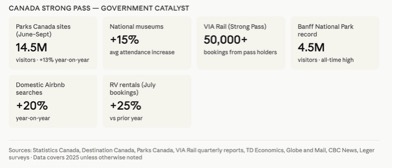
National parks in Canada have experienced a surge in visitation. Parks Canada reported 14.5 million visitors between late June and early September 2025 which was a 13% increase over the same period in the previous year. Banff National Park recorded 4.5 million visitors for the 2025–26 fiscal year- its highest ever annual visitation figure – surpassing a previous record of 4.28 million 2023. Rail travel surged too. VIA Rail, Canada’s national passenger rail operator, saw passenger numbers grow by 16.3% in the third quarter of 2025 compared to the same quarter in 2024.
While these changing patterns of tourist demand may not have been anticipated in the US, the possibilities were recognised in Canada. The Canadian federal government introduced the “Canada Strong Pass” offering free admission to national parks, discounted museum entry, and subsidised VIA Rail travel in response to growing anti-American sentiments.
Interestingly, it was not just Canadians who redirected their travel toward Canada. European visitors who might otherwise have gone to the United States have clearly considered Canada a worthy alternative. Overseas visitor arrivals in Canada grew by 7.5% in 2025. UK visitors increased by 14% in April. Mexican visitors rose 22%. A survey of 1,560 people in the UK, France and Germany found that just over half said they were more likely to visit Canada as a result of the current political climate in the United States, with more than 90% viewing Canada as a friendly and safe place to visit.
Data summarised by Claude.ai
There is a lesson in all of this and that is – that tourism is political.
The decision of where to travel, and where not to travel, is shaped by perceptions of safety, by feelings of being welcome or unwelcome, and by questions of values and identity. When a government pursues policies that make people feel surveilled, suspected, or unwanted, tourists will vote with their feet. Not in every case, and not immediately — but over time, it becomes clear that tourist demand is powerful.
The United States built a global tourism industry on a perception of openness and freedom which it fiercely defended. That story has been a competitive advantage for generations. It is unlikely to be destroyed in a single presidential term but it can be damaged and how it might be repaired is uncertain.
In the meantime it has set in motion some changes that will not be reversed. Gossling’s Trump v Europe is likely to see a shift away from dependence on America that will not be reversed. Canada – a country that has sometimes struggled to define its tourism identity in the shadow of its tourism powerhourse neighbour – has emerged a winner from America’s threatening foreign and domestic policies.
Canadian PM Mark Carney encouraged Canadians to realise that when they choose to spend their holidays at home, exploring their own national parks, taking their own trains, staying in their own lodges, they are not just making an economic choice. They are making a statement about who they are, and what they value. They are expressing a sense of national identity.
*****
Interestingly, as we will see in the weeks ahead, just as tourism is deeply political so too are sports events. In early 2026, FIFA, the governing body of world football, an organisation with a long and distinguished record of ethically questionable decision-making, awarded Donald Trump the FIFA Peace Prize.
FIFA’s decision to award this prize tells us something important about FIFA. That football’s global body is open to exactly the kind of transactional politics that Hall and Gössling describe. This leads me to wonder if football fans globally will also consider travelling to matches held in the USA is a political choice. When a country treats visitors as suspects will it be considered worthy of support from football fans? Perhaps fans will be prepared to watch games in the co-hosting countries – Mexico and Canada – but not the US. Football fans are passionate and may be prepared to ignore these geopolitical pressures. If they do travel to America for football games how will they express themselves? Or will they also retreat from America and boycott the world cup altogether? I will be watching with interest.
References
Calder, Simon (2026). ‘I won’t go near Donald Trump’s America’: Readers on why tourists are ditching US trips. The Independent, 30 January 2026. https://www.independent.co.uk/travel/americas/us-holidays-america-trump-ice-uk-b2910105.html
Destination Canada. (2025). Record-breaking summer 2025 tourism results. Destination Canada. https://www.destinationcanada.com/en-ca/news/canadian-tourism-delivers-almost-60b-this-summer-driving-national-wealth-and-unprecedented-dispersion-across-the-country
Gössling, S. (2026). Trump vs. Europe: critical roles for tourism? Journal of Sustainable Tourism. https://doi.org/10.1080/09669582.2026.2628115
Hall, C. M. (2026). Will this editorial prevent me from travelling to the United States? Geopolitical change and the meta-governance of tourist mobility in the contemporary world. Current Issues in Tourism, 29(1), 1–11. https://doi.org/10.1080/13683500.2026.2614129
Kleeman, Jenny. (2026). ‘Don’t go to the US – not with Trump in charge’: the UK tourist with a valid visa detained by ICE for six weeks. The Guardian, 21 February 2026. https://www.theguardian.com/us-news/2026/feb/21/karen-newton-valid-visa-detained-ice
Leger. (2026). Travel trends Canada: Canadians are travelling more as U.S. travel slows and domestic trips rise. https://leger360.com/in-the-news-travel-trends-canada-us-travel-declines-travel-intentions-leger-2026/
Parks Canada. (2025). Attendance data for national parks and historic sites 2024–25. Open Government Portal. https://open.canada.ca/data/dataset/59fb63af
Statistics Canada. (2026, February 23). Travel between Canada and other countries, December 2025. https://www150.statcan.gc.ca/n1/daily-quotidien/260223/dq260223a-eng.htm
TD Economics. (2025). From border blues to local boom: Canada’s 2025 tourism spending outlook. https://economics.td.com/ca-tourism-spending-outlook-2025
VIA Rail Canada. (2025). Third quarter report 2025. https://media.viarail.ca/sites/default/files/publications/VIA%20Rail_Quarterly%20Report_Q3_2025.pdf