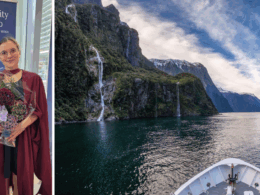
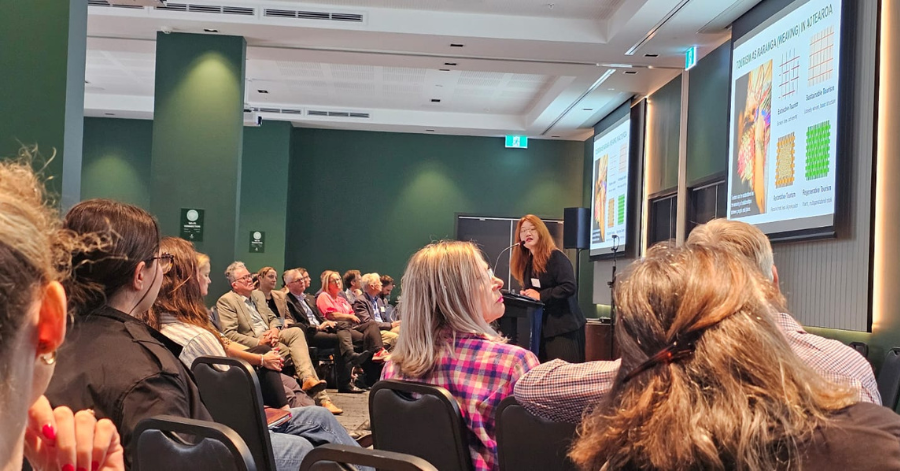
Last month my Research Assistant Yi Bian and I launched a report on Regenerative Tourism to government and industry at the Tourism Policy School Research Forum in Queenstown. Today, we are making the report publicly available – supported by today’s podcast.
Transcript
JH: Last month, at the Otago Tourism Policy School in Queenstown, my student Yi and I had the opportunity to launch a new report on regenerative tourism, drawing on insights from Aotearoa New Zealand. Regular listeners will remember Yi. She was the first person that I interviewed for a podcast. That was Episode 38 – the last podcast of Season 2 – which landed at the end of November 2025. Just to remind you, that was soon after Yi has presented at the Adaptation Futures Conference in Ōtautahi Christchurch. The podcast was titled ‘Nourishing what feeds us’ and was informed by her PhD research which examines conditions for alignment of ecological restoration and regenerative tourism in Aotearoa New Zealand.
Last year was a busy year for Yi because while advancing her PhD field work and data analysis she was also working with me as a Research Assistant on our MBIE Endeavour Research Programme, He Karapitipitinga Mariko. We were preparing a report on Regenerative tourism to inform our Endeavour research on extended reality technologies and the delivery of immersive, regenerative experiences. The report, which was completed in October 2025, was initially intended for internal purposes only, to inform all members of the collaborative research team on regenerative tourism policy and practice.
When we were invited to speak at the Tourism Policy School, we decided that this might also offer the opportunity to share the report more widely. The report provides comprehensive insights and analysis, offers theoretical contributions and is informed and illustrated by selected case studies that profile four contrasting and insightful regenerative tourism businesses in Aotearoa.
So rather than limiting the readership of the report to our research team, we decided to launch the report in the Tourism Policy School Research Forum that took place in Queenstown on Thursday 26 March. And to extend the reach of the report beyond the TPS delegation, we thought we would dedicate a podcast to the report – to take some time to talk it through together, what it sets out to do, and perhaps more importantly, the questions it begins to open up.
So Yi, thank you for podcast #38 and welcome back to the conversation today for podcast #41!
YB: Thank you James. It’s really lovely to be back.
JH: Yi, perhaps we can start most broadly. How does this report relate to your PhD and how does it build upon or extend your PhD research?
YB: So my PhD looks at the relationship between ecological restoration and regenerative tourism in Aotearoa New Zealand. There is a growing expectation that bringing these two together can help address climate change and biodiversity loss at the same time, and contribute to what is often called nature positive outcomes. But I try not to assume that this automatically happens. Instead, I look at when and how that alignment actually works in practice, and when it does not. So the research combines conceptual work with fieldwork, which was conducted in Coastal North Otago, working with restoration groups and tourism operators to understand how these relationships play out on the ground.
The MBIE programme has been a really valuable extension of that. My PhD goes quite deep into one region and tries to unpack the conditions under which regenerative tourism and ecological restoration can contribute to nature positive outcomes. The report lets us step back and think more broadly across Aotearoa, and explore how those conditions might translate into different contexts. It also brings the work much closer to policy and implementation, which is something my PhD points to, but cannot fully do on its own.
And that is also why it is important to bring these ideas to a wider audience. In academia, concepts like regeneration or nature positive can stay quite abstract, but whether they actually lead to change depends on how they are taken up by government and industry. Through the report, we can communicate these ideas in a way that is more usable, and connect them to real decisions and practices. Because achieving nature positive outcomes is not just about having the right ideas, it depends on how different actors work together and take shared responsibility over time.
So James, what made you feel that now is the right moment to publish this report?
1. Why publish this report?
JH: For me, this report comes out of almost three decades of working in sustainable tourism. Sustainable tourism has achieved a great deal. It has helped the sector take environmental impacts, community wellbeing and carbon emissions much more seriously. But after thirty years, I think we can also see its limits. Too often, sustainable tourism has become about managing harm more efficiently, rather than transforming the system that creates that harm.
That matters especially in Aotearoa New Zealand. Tourism here depends heavily on long-distance travel, so carbon-neutral or net-zero claims can be problematic if they only account for balancing emissions. And responses like tree planting can sound positive, but without long-term monitoring and ecological restoration, they may not lead to meaningful regeneration. In fact as we now know beyond any doubt, planting the wrongs sorts of trees, on the wrong sort of land can be very counter-productive.
We produced this report to inform an interdisciplinary research team with contrasting understandings of regenerative tourism, and how it differs from sustainable tourism, responsible tourism or ecotourism. This is critically important because all of these terms have long been debated in the literature, and their merits are contested. Furthermore, regenerative tourism is a term that emerged from the COVID disruption and it has proved difficult to define and conceptualise. But for a small number of high quality publications, it remains very poorly developed theoretically.
So we decided to publish this report because regenerative tourism is now entering policy and industry language, but it still needs conceptual clarity. People are using the term, but not always in the same way. I would not describe this report as moving away from sustainable tourism. I would describe it as building on it. The question is no longer only how tourism can reduce harm, but how it can actively give back to the places and communities that tourism depends on.
2. What questions does the report try to answer?
YB: Yes, and I think that point about building on sustainability is really important.
One thing we kept coming back to while writing the report was that regenerative tourism is being used more and more, but often without a shared understanding. So perhaps the question is not just what regenerative tourism is, but what kinds of questions we actually need to ask.
From your perspective, what do you see as the key questions this report is trying to open up?
JH: I think there are a few central questions that we address.
First, what do we actually mean by regeneration in a tourism context? The term has become more widely used, but it is rarely clearly defined. That can cause doubt which can in turn give rises to cynicism. It puts regenerative tourism at risk of being framed as a meaningless buzzword or a means of greenwashing tourism if nothing actually changes for the better.
Second, how is regenerative tourism different from sustainable or restorative tourism? There is a risk that these ideas become blurred, and used interchangeably.
And third, what kinds of outcomes should regenerative tourism produce, and for whom? Is it about carbon, biodiversity, community wellbeing, cultural revitalisation, or all of these together?
Those questions are not just conceptual. They go to the heart of how tourism is designed, governed and experienced.
YB: I think that last point is really where the complexity lies.
Because once we start asking who defines regeneration and what outcomes matter, it becomes clear that this is not just a technical question. It is also about values, relationships and whose knowledge counts.
So in that sense, the report is not trying to provide a single definition, but to create space for a more grounded and, hopefully, more honest conversation about what regeneration might look like in practice.
3. What is regenerative tourism?
JH: So Yi, regenerative tourism sits at the centre of your PhD. Based on your research, how do you understand regenerative tourism?
YB: That’s a big question, James, and I’m still working through it.
But one way I have found helpful, especially in the New Zealand context, is to step slightly outside tourism and think about something much more familiar here, which is agriculture.
New Zealand is a deeply agricultural country, and many people, even if they are not farmers, have an intuitive sense that land cannot just be used, it has to be cared for over time.
So in the report, we use regenerative agriculture as a starting point. In that context, regeneration is not just about maintaining productivity or reducing harm. It’s about how a system sustains its vitality, how soil, water, biodiversity and knowledge are held in balance so that the land can continue to support life across generations.
When we bring that thinking into tourism, it shifts the question quite fundamentally. Tourism is no longer just about minimising impacts, but about how it participates in the ongoing life of a place.
JH: So you are suggesting that tourism could be understood in a similar way to how we think about land use?
YB: Yes, in a way. Because once we start thinking like that, it becomes much harder to separate tourism from the places it operates in.
And in my research, what becomes really important is that this is not only about environmental conditions, but also about relationships. It’s about how tourism connects people to place, how it engages with local knowledge, and how responsibility for care is shared over time.
So regeneration is not something tourism delivers as a product. It’s something that emerges from how those relationships are formed and sustained.
JH: That makes it quite difficult to define then.
YB: It does. And I think that’s partly why there is so much ambiguity around the term. Because if regeneration is relational and ongoing, it doesn’t fit neatly into a fixed definition. What we see instead is a spectrum. Some forms of tourism remain extractive, some focus on reducing harm, and others begin to reconfigure relationships in more meaningful ways. So for me, regenerative tourism is less a label, and more a direction of change. It’s a shift in how tourism understands its role, from something that uses a place, to something that is entangled with its life over time.
JH: So it’s as much about how we think about tourism as what we do in tourism?
YB: Yes, exactly. And I think that’s why using agriculture as an entry point can be helpful. It gives people something familiar to hold onto, while opening up a different way of thinking about tourism.
4. Tensions in regenerative tourism
JH: Yi, one of the things we spent quite a bit of time on in the report was reviewing how regenerative tourism is being taken up in different countries.What did you find when you looked across those policy and industry frameworks, both in Aotearoa and internationally?
YB: What I found quite striking is that regenerative tourism is now being taken up in many different contexts, in Aotearoa, but also in places like Canada, the Nordic countries, Ireland and the UK. Across the frameworks that now existing in these countries, there is a strong shared ambition. Regeneration is often framed as a shift beyond sustainability, towards tourism that contributes positively to environments and communities. But when you look more closely, some consistent tensions begin to emerge.
JH: Investigating and being informed by regenerative tourism policy and practice both in Aotearoa New Zealand and internationally was a key focus of our research, but in the process we identified some tensions that we highlighted in the presentation to the TPS Research Forum
YB: Yes, the first is a tension between growth and limits.
Many national strategies still position tourism as an engine of economic growth, even while talking about regeneration. So there is an open question about whether tourism can continue to expand, while also operating within ecological limits.
JH: So problems arise when regeneration is layered onto an existing growth model?
YB: Yes, and that creates a kind of unresolved tension.
The second is between vision and delivery. Across both international and New Zealand policy statements and reports, the language of regeneration is often quite ambitious. It speaks about long-term value, stronger communities, and more balanced relationships with place. But when it comes to implementation, the pathways are often less clearly defined.
JH: And the third?
YB: The third is between narratives and measurement. Regeneration is a compelling idea, but there are still limited ways of demonstrating what it actually looks like in practice. Different frameworks prioritise different outcomes, and there is no shared way of bringing them together.
JH: And we found that this tension plays out in different parts of the world, and Aotearoa specifically, in some quite unique, and specific ways
YB: I think in Aotearoa, these tensions are particularly visible in how different organisations frame regeneration.
For example, MBIE tends to approach regenerative tourism in terms of system transitions and measurable outcomes, often linking it to innovation, economic value and sector transformation. Whereas DOC places more emphasis on stewardship, kaitiakitanga, and long-term relationships with land, water and ecosystems.
So it’s not necessarily a conflict, but it does show that regeneration is being understood through different lenses, depending on institutional priorities.
JH: So even within one country, regeneration is not a single, unified idea.
YB: Exactly and I think that’s important, because it reminds us that regenerative tourism is still being negotiated. Rather than trying to resolve these differences too quickly, the report tries to make them visible, so we can better understand what is at stake.
JH: Thatbrings us to the next question, if regenerative tourism is being understood in different ways, how do we make sense of it conceptually?
YB: Yes, and that’s where I have been trying to think about tourism through the idea of relationships, and more specifically, through raranga.
5. Tourism as raranga (weaving)
JH: In the TPS presentation you introduced the idea of tourism as raranga, or weaving.
For listeners who may not be familiar with the term, could you explain what raranga means – both practically and conceptually, and why it is so informative in terms of how we understand regenerative tourism in Aotearoa?
YB: Yes, and I think it’s really important to begin carefully here.
Raranga is a Māori concept, and I want to be very clear that I’m not speaking on behalf of mātauranga Māori, or for any iwi, hapū and whānau. What I’m sharing is my own interpretation as a researcher who has been learning from Māori tourism practitioners and communities, and trying to engage with that learning in a respectful way.
In te ao Māori, raranga, or weaving, is not just a craft. It is a way of understanding relationships. It reflects how people, land, knowledge and ancestors are connected, not as separate elements, but as part of an ongoing, living pattern.
JH: So weaving here is not just a metaphor, it carries a deeper way of seeing the world?
YB: Yes, it’s about interconnection and responsibility. In weaving, each strand only holds meaning in relation to others. Strength comes not from individual threads, but from how they are brought together over time. And that way of thinking has really shaped how I understand tourism.
JH: In what sense?
YB: If we think of tourism through raranga, it shifts our attention away from individual impacts or outputs, and towards the relationships that tourism creates, sustains, or disrupts. Some forms of tourism might weaken those relationships, by extracting value from a place without maintaining connections to it. Others might try to hold things together, or repair certain aspects. But what I’m interested in is how tourism might contribute to patterns of relationship that are more enduring, more reciprocal, and more attentive to the life of a place over time.
JH: So tourism becomes less about activity, and more about the quality of relationships it is part of?
YB: Yes, that’s exactly how I see it. And I think raranga helps us to move away from thinking of tourism as something that happens in a place, towards something that is entangled with that place, across time, across people, and across different forms of knowledge. It also brings an ethical dimension. Because if we are part of the weave, then we are also responsible for how that weave is held together.
JH: This of course is a very different way of thinking about tourism. It is a very different way of thinking to, for example, sustainable tourism which seeks to minimise harm and minimise the unsustainable use of resources. The focus on relationships is a different frame of thinking – it hints towards a different tourism paradigm altogether.
YB: It does, and I think it also helps explain why regeneration is so difficult to define or measure. Because if what matters are relationships, then we are not just dealing with outputs, but with something ongoing, something that requires care, attention, and time.
6. If tourism is relationships, how do we measure them?
YB: So if we take that idea seriously, that tourism is fundamentally about relationships, not just activities or outputs, then it raises quite a difficult question. How do we actually measure something like that?
James, from your perspective, how do we begin to think about measuring regenerative tourism?
JH: Yes, it is a difficult question, and I think it goes right to the heart of the challenges we have been discussing.
Traditionally, tourism has been measured through indicators that are relatively easy to quantify – indicators such as visitor numbers, expenditure, employment, and more recently, carbon emissions. These metrics have been useful, but they also shape what we pay attention to and – by implication – what we don’t pay attention to. It raises questions about who has the power to define what is (and therefore what is not) important.
If we begin to understand tourism in relational terms, then the deficiencies of conventional indicators become apparent. They capture flows and outputs, but not necessarily the quality of relationships between people and place.
So the first issue is that measurement is not neutral. It reflects particular values and priorities. What we choose to measure often determines what we see as success.
YB: So in a way, measurement is already shaping the kind of tourism we end up with?
JH: Yes, and that’s where things become more complex with regenerative tourism. Because regeneration involves multiple dimensions – ecological, social and cultural – and these unfold over very different timeframes. Some outcomes may take decades to become visible. Others may not be easily expressed in quantitative terms at all. So rather than looking for a single metric, or for sets of metrics, I think what we need are more plural and context-specific ways of understanding value.
YB: Does that mean moving away from measurement altogether?
JH: Not necessarily. I think measurement still has an important role, particularly in policy and governance. But it needs to be complemented by other forms of understanding. That might include qualitative insights, local knowledge, and forms of evaluation that are grounded in place. It may also require us to accept that not everything that matters can be easily measured or compared.
YB: So it’s less about finding the perfect indicator, and more about recognising the limits of indicators themselves?
JH: Yes, that’s a good way of putting it. If regenerative tourism is about relationships, then what we are really trying to understand is how those relationships are formed, maintained, and whether they support the long-term wellbeing of people and place. That kind of understanding requires not just data, but ongoing engagement, reflection, and, I would say, a degree of humility.
YB: Yes, and I think that links quite closely to the idea of raranga as well. Because if tourism is part of a living weave of relationships, then what we are observing is something that is always evolving, rather than something that can be fixed and fully captured at a single point in time.
7. Case studies and closing
JH: The report also draws on a number of case studies from Aotearoa. We won’t go into those in detail here, but they do provide some really rich and grounded insights into how these ideas are being interpreted and practiced.
YB: Yes, and I think that’s really important. Because one of the things we found is that regeneration doesn’t look the same in every context. It’s shaped by place, by people, and by the kinds of relationships that already exist and the kinds of relationships that need to be repaired. So rather than presenting these cases as fixed models, we see them more as ongoing practices, each working through its own challenges and possibilities. And that opens up an opportunity for future conversations.
JH: Yes, definitely. Rather than speaking about these cases on behalf of the businesses that we worked with, I think it would be much more meaningful to invite those business leaders to share their own experiences on their own terms. So hopefully, in future Checking In podcast episodes, we can bring some of those voices into the conversation.
YB: That would be great. And I think something that also comes through quite strongly in the case studies is that they start to raise questions about how regenerative tourism leadership is actually recognised and supported. What we see is that a lot of this work is being driven by really committed communities and businesses, often grounded in ideas like kaitiakitanga, but in many cases that mahi is still largely carried by the communities and businesses themselves, rather than being consistently supported through government policy or funding structures.
There is also a question of continuity. Because policy settings can shift over time, support for this kind of work can sometimes feel quite short term or project based. And that can be challenging for communities and businesses that are trying to do ecological restoration, which is inherently long term and dependent on continuity over time. So one of the questions the report raises is what it would look like to have more enduring forms of support, something closer to the long-time horizons we see in initiatives like Predator Free 2050, or in many restoration efforts that are thinking in decades or centuries rather than short-term funding cycles.
At the same time, it also highlights the importance of Māori leadership in this space. Not just in terms of participation, but in terms of the knowledge systems and worldviews that shape how relationships with land, species, and community are understood. That feels really central to what regenerative tourism could become in Aotearoa.
Even at this stage, before we go deeper into the individual cases, the report is already pointing to a broader question around what more informed regenerative tourism policy might look like, and how it can better recognise, support, and sustain what is already happening in practice.
So perhaps to close, what do you hope listeners take away from this report?
JH: For me, the takeaway is that regenerative tourism should not be treated as a slogan or an appealing but vague, rather meaningless and fleeting buzzword. After many years of researching sustainable tourism, I see it being rich in possibilities – but also challenging in terms of deepening the sustainability agenda.
It asks us to confront the limits of harm reduction, and to think more seriously about the systems that tourism depends on, including climate, biodiversity, communities, culture and place. So if listeners take one thing from the report, I hope it is this: regeneration is not simply about making tourism look better. It is about asking whether tourism can be reorganised so that it contributes to the long-term wellbeing of the places and people on which it depends.
****
Thank you Yi – for working with me on this research project, co-delivering the report at the Tourism Policy School Research Forum last month, and for co-producing this podcast. I look forward to your PhD being submitted for examination in the weeks ahead. And to continuing this line of research, to inform the intersection of research, policy and governance in regenerative tourism.
References:
Higham, J.E.S. & Bian, Y. (2026). Regenerative tourism: Systems, technology and experiences. MBIE Endeavour Programme – He Karapitipitinga Mariko. Griffith University. March 2026. https://jameshigham.com/wp-content/uploads/2026/05/Regenerative-Tourism-Report-March-2026-FINAL-180526.pdf
Bian, Y., Higham, J., Ellis, L., & Mackey, B. (2025, Oct 13-16). Ecological Restoration as Mahinga Kai: Policy Pathways to Avoiding Maladaptation in Regenerative Tourism in Aotearoa New Zealand [Conference presentation abstract]. Adaptation Futures Conference 2025: Accelerating Adaptation Action, Christchurch, New Zealand.
Bian, Y., Higham, J., Ellis, L., & Mackey, B. (2026). Representational issues of CO₂ in tourism climate equations. In J. Wen, M. Kozak, J. Aston, & W. Wang (Eds.), Interdisciplinary research: Tourism, sustainability, law and marketing (pp. 13–30). Routledge. https://doi.org/10.4324/9781003500230-3
Bian, Y., Higham, J., Ellis, L., & Mackey, B. (2026). Structural issues of biodiversity in tourism and climate justice. In J. Wen, M. Kozak, J. Aston, & W. Wang (Eds.), A research agenda for just tourism futures (pp. 136–152). Edward Elgar. https://doi.org/10.4337/9781035346172.00012