



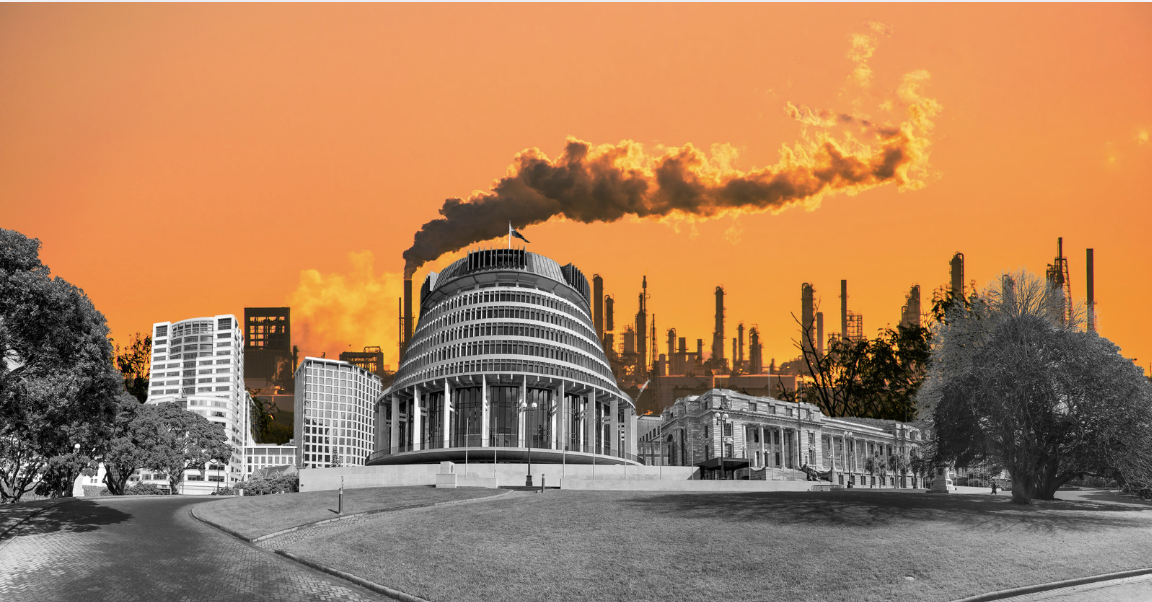
Last month the New Zealand’s government announced it was introducing legislation to parliament to strip New Zealand citizens of the right to take legal action against major climate polluters. It turns out that this was the tip of an iceberg that has important implications for climate change action in tourism.
Transcript
It has been quite a week for climate politics in New Zealand. This is a story that deserves the public scrutiny that it has – very belatedly – received. And it has important implications for sustainable tourism.
Two weeks ago the coalition government announced that – against official advice – it was introducing legislation to parliament to retroactively strip New Zealand citizens of the right to sue major climate polluters. It announced that it would amend climate laws to prevent companies from being sued over damage caused by greenhouse gas emissions. Justice Minister Paul Goldsmith said it would apply to current and future cases. Goldsmith said the law change would “remove the possible development of a new regime that contradicts the framework Parliament has already enacted to respond to climate change”.
In actual fact, despite the rapidly growing importance of climate litigation as a tool for climate action internationally, this was not the headline story.
It transpires that the legislation was essentially written two years ago by the very corporations standing to benefit from it. Two of the country’s biggest greenhouse gas emitters drafted, in ready-prepared statutory language, the law they wanted Parliament to pass. The draft was delivered in the form of printed copies to the Prime Minister’s office. Strange that in the electronic age someone would go to the bother of printing and hand delivering you would think. Two years later, the Justice Minister announced the very same change as government policy. When questioned on this the Prime Minister’s office stated that it has no record of any interactions with those corporations.
What now seems to be beyond dispute is that in June 2024, a Fonterra government affairs representative hand-delivered a printed briefing note to a staffer inside the Prime Minister’s office. A few weeks later, Z Energy did the same, delivering a largely identical document to the same adviser. For international listeners Fonterra and Z Energy are national dairy and energy companies and two of New Zealand’s highest producers of greenhouse gas emissions.
The document argued that legislative intervention was “necessary and appropriate” to eliminate tort-based climate litigation. It then proceeded to outline a “two-sentence legislative amendment” to the Climate Change Response Act. The draft was intended to retroactively strip New Zealanders of any common-law right to bring climate damage claims.
The plot then thickens. As it happened, law change has stopped a landmark case against Fonterra and five other major emitters. Reporting for RNZ, Lilian Hanly explained that “Iwi leader and climate activist Mike Smith has accused the Government of a co-ordinated campaign of secret lobbying, political interference and corporate influence at the highest levels of power”. Mr. Smith (Ngāpuhi and Ngāti Kahu kaumātua) is engaged in a Supreme Court-sanctioned case that he has been trying to bring to trial since 2019. The mystery document appeared to have been prepared largely or entirely by the law firm Chapman Tripp acting for the defendants in Smith v Fonterra.
The Prime Minister and Justice Minister have framed this as simply a matter of “business certainty” and avoiding “uncertainty in business confidence and investments”.
****
Normal stakeholder engagement or corporate lobbying?
It is a critically important question. Either way, this climate law change has exposed a corridor of influence between the country’s largest corporate emitters and the office of the Prime Minister. Not to mention a lack of transparency coupled with pleas of ignorance to keep these deeply troubling policymaking processes hidden from public view.
This is also a story of a disappearing paper trail.In March 2025, Dr Matt Hall of the Environmental Law Initiative (ELI) filed an Official Information Act request to the Prime Minister’s office requesting all records of meetings, internal policy discussions and documents relating to Smith v Fonterra and the proposed legislative or regulatory response to it. That OIA request would of course include a hand-delivered briefing note from two of the country’s largest companies proposing the very legislative response the request concerned.
After much delay the Prime Minister’s Office released a limited set of heavily redacted emails and text messages with no mention of meetings with Fonterra or Z Energy advisors and no briefing note, or any indication whatsoever that those drafted documents ever existed. A similar OIA request from Lawyers for Climate Action New Zealand came up equally emptyhanded, with the printed note to the Prime Minister’s Office remaining hidden from public view.
The document only came to light because a High Court judge refused to accept the corporates’ confidentiality claims and ordered the documents to be released to the public. In December 2025, the court ordered the defendants to disclose lobbying-related documents by 27 March 2026. What followed was further delays, a series of missed deadlines, further claims of confidentiality … and when a persistent court system finally brought the document into the public domain, the Government had already announced its law change.
The Prime Minister, when questioned by the media, stated that “We have been made aware of these meetings and briefing notes via the media and have no record of either on file,” adding that “Cabinet makes its own decisions”.
Not to be denied, the Environmental Law Initiative (ELI) said it had sought information in March 2025 about meetings, discussions or conversations regarding the Smith case, and any proposed legislative or regulatory response. Dr Matt Hall, the group’s research and legal director, responded that it received “only limited material” and that “To see this document emerge later in such an important case is deeply troubling”. ELI has called for an Ombudsman inquiry and a Solicitor-General review, due to the document not being disclosed as part of its official information request.
Mike Smith deserves the last word on this shameful matter. He said it increasingly looked like a “cover-up of secret lobbying between the government and some of the country’s most powerful corporate interests”. “This is not just about climate change anymore,” he said. “This is about whether billion-dollar corporations can use their political access to shut down legal challenges they do not want to answer.” This is a “co-ordinated campaign of secret lobbying, political interference and corporate influence at the highest levels of power”. It is hard to disagree with him.
****
The appalling state of climate politics in New Zealand is, of course, completely at odds with countries that are trying to lead on climate action by holding mega carbon emitters to account. Climate litigation is a key point of action to counter the corporate interests of the biggest climate polluters. It tells us much about the lobbying interests and backroom deals that are preventing action and progress on emissions in New Zealand, despite such widespread intentions and heightened urgency.
As long as this sort of politics is taking place there is little or no possibility that New Zealand will fulfil its potential as a global sustainable tourism leader. Certainly not when we see what climate action leadership looks like elsewhere in the world.
Take for example cities in Europe and elsewhere around the world where civic leaders are taking decisive action against the big polluters. In January this year Amsterdam’s city council passed a legally binding ban on ads for high fossil fuel and meat products – the first capital city in the world to do so. The ban includes high-carbon products and services that are critical to tourism – like flights, cruises, petrol and diesel vehicles, gas heating contracts and meat products. The advertising ban applies to all public spaces in Amsterdam, including on public transport.
In February the City Council of Florence voted to become the first city in Italy to formally adopt a ban on fossil fuel advertising in public spaces. The ban concerns ads for flights, cruises, fossil energy contracts and petrol and diesel vehicles. More than 50 cities around the world have now restricted or initiated plans to restrict fossil fuel advertisements including Stockholm, Edinburgh, and Sydney.
****
Sadly the case of climate politics in New Zealand is depressingly familiar.
Recent politics in Wellington will come as an setback to the tourism leaders and visionaries in business, national and regional tourism organisations, policy communities, conservation and environmental agencies and academia who have – individually and collectively – invested so much commitment to climate action in tourism in New Zealand in recent – and not so recent – years.
To highlight this climate action commitment in tourism we don’t have to look back very far at all. Rewind to 2022 when, as we began to look to the future of tourism after the COVID pandemic, the Aotearoa Circle convened a programme of work on Tourism Adaptation focussing on climate action. The Aotearoa Tourism Adaptation kaupapa was co-chaired by three tourism visionaries – Laurissa Cooney from Air New Zealand and Tourism Bay of Plenty, Tak Mutu from MDA Experiences and Penny Nelson the Director General of Te Papa Atawhai the Department of Conservation.
They were supported by a leadership group that was a who’s who of tourism vision, leadership and ambition – Grant Webster (THL), Kiri Goulter (RTNZ), Rebecca Ingram (TIA), Jo Allison (Ngāi Tahu Holdings) among them. Through a series of workshops held in the middle months of 2022 the wider tourism community came together in a powerful expression of commitment to action on tourism and climate change, giving lots of reasons for optimism.
In the Aotearoa Circle report that was made public in the latter part of 2022 the co-chairs noted how the impacts of Cyclone Gabrielle brought the realities of climate change and a great sense of urgency into sharp focus. That urgency is to safeguard our tourism brand promise and reputation by acting on and adapting to climate change. It noted that to do this requires a societal shift in mindset. All partners and stakeholders need to have a seat at the table and be the driving forces that hold firm to the future. All must recognise that climate change action must be accelerated. Powerful words indeed.
The Aotearoa Circle kaupapa explored a number of possible future climate scenarios. They included:
- The Hiahia scenario – This orderly scenario represents a smooth transition to global net zero by 2050 limiting global warming to 1.5C by the end of the century through stringent climate policies and innovation. It assumes that polices are introduced immediately and become progressively more stringent as target dates approach. Getting to net zero is ambitious but the reward is relatively subdued transition risks.
- The Pokanoa scenario – This represents a disorderly transition caused by little policy action until 2030 after which strong intervention and rapid action is needed to limit warming to 2C. Emissions continue to increase and carbon budgets are not met. Transition risks are higher, more costly and disruptive.
- The Wharewera scenario – This is the hothouse scenario which describes a world in which emissions continue to rise unabated. Warming is expected to reach higher than 3C by 2080. The physical impacts of climate change are severe. Irreversible change include glacier melt and sea level change. Adapting to climate change becomes the priority while physical climate events impact the economy and financial system long term.
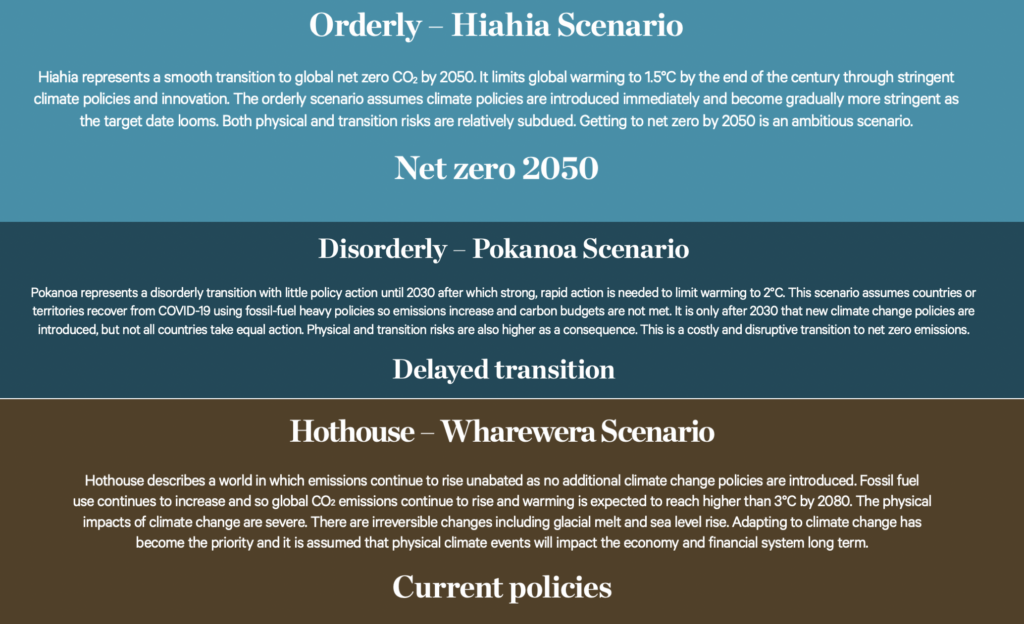
Source: Aotearoa Circle (2022).
These scenarios all unequivocally demonstrate that a changing climate will make things harder for tourism, but how much harder will depend on our actions and how quickly and proactively we respond. The business owners and managers, scientific and economic experts, policy and strategy specialists, professionals in the environment and mātauranga Māori all contributed to developing the Tourism Sector Climate Change Scenarios and Adaptation Roadmap. I think everyone involved felt that it was an uplifting and promising experience to be able to contribute to this kaupapa. There was universal agreement on the need for climate change action in tourism.
****
Four years later the Aotearoa Circle Adaptation Roadmap seems to have been completely forgotten. Added to the pile of excellent strategy documents that have been discarded and left in a dark corner to gather dust. Indeed four years after the Aotearoa Circle workshops in June 2022 – almost to the day – the cruise industry had an exclusive audience with five ministers in Parliament.
TIA reported this week that it attended a Cruise Forum in Parliament, where cruise lines, the New Zealand Cruise Association and other key players met with five ministers whose portfolios touch the cruise industry. It noted that cruise has a “major flow on effects for wider tourism across the country, from accommodation and activities to hospitality and the spend of both crew and visitors, so this was a good opportunity to discuss how we grow the sector again”.
This is the same cruise sector that is New Zealand’s highest emitting form of tourism. The same industry that has or is having its advertising banned in cities in Europe and increasingly around the world. The same TIA that was part of the leadership group for the Aotearoa Circle Tourism Adaptation Roadmap kaupapa. And the same access to Ministers by industry organisations and corporate lobbyists seeking to shape and influence government policy.
*****
Last year in my podcast about the need for a National Tourism Development Authority in New Zealand, I noted that it is really important for us to pause and reflect and think about the evidence base for tourism? How is that evidence base produced and communicated? How is it taken up and acted upon? And how does it inform policy that supports tourism regions and businesses as well as environment and society? These are critical questions.
A National Tourism Commission or National Tourism Development Authority exists and works very well in some countries overseas. They provide guidance on funding and investment for tourism related infrastructure and oversee registration and grading. They oversee regional experience brands and coordinate regional, destination and national marketing programmes. They maintain research databases that inform tourism policy development on an ongoing basis. And they identify and address development challenges such as climate change.
In the continued absence of a national tourism authority, tourism in New Zealand remains crippled by disparate interests and lack of coordinated direction. Climate action is a case in point.
Tourism climate action is perhaps the great failure of sustainable tourism in New Zealand. Where is the tourism leadership that was so evident in 2022? In 2022 there was great optimism across the industry of transition to a new normal. In 2022 industry leaders and visionaries came together to imagine and create pathways to a climatically and environmentally sustainable future for tourism in New Zealand.
****
New Zealand desperately needs far more trustworthy political leadership, and far greater transparency in the influence of corporate lobby interests in political decision making and policymaking.
It also desperately needs a National Tourism Commission to try to ensure that tourism planning and strategy is one step removed from the politics of the day. Such a national tourism commission would need to be led by someone with vision and passion, energy and determination, and a single-minded commitment to an aspirational, action-based development pathway for New Zealand tourism.
Someone who has demonstrated sustained and outstanding vision and leadership in tourism, including strategy programmes such as We are Aotearoa, and the Aotearoa Circle Tourism Adaptation Plan and regional tourism planning and strategy. Actually… I think I know the perfect person for the job!
References:
Aotearoa Circle (2022). Tourism Adaptation Roadmap.
Edwards, B. (2026). Democracy Briefing: The lobbyists who wrote the climate law.
Hanly, Lilian (2026), Climate law change: Inquiry sought over PM’s office lobbying claims. Radio New Zealand.